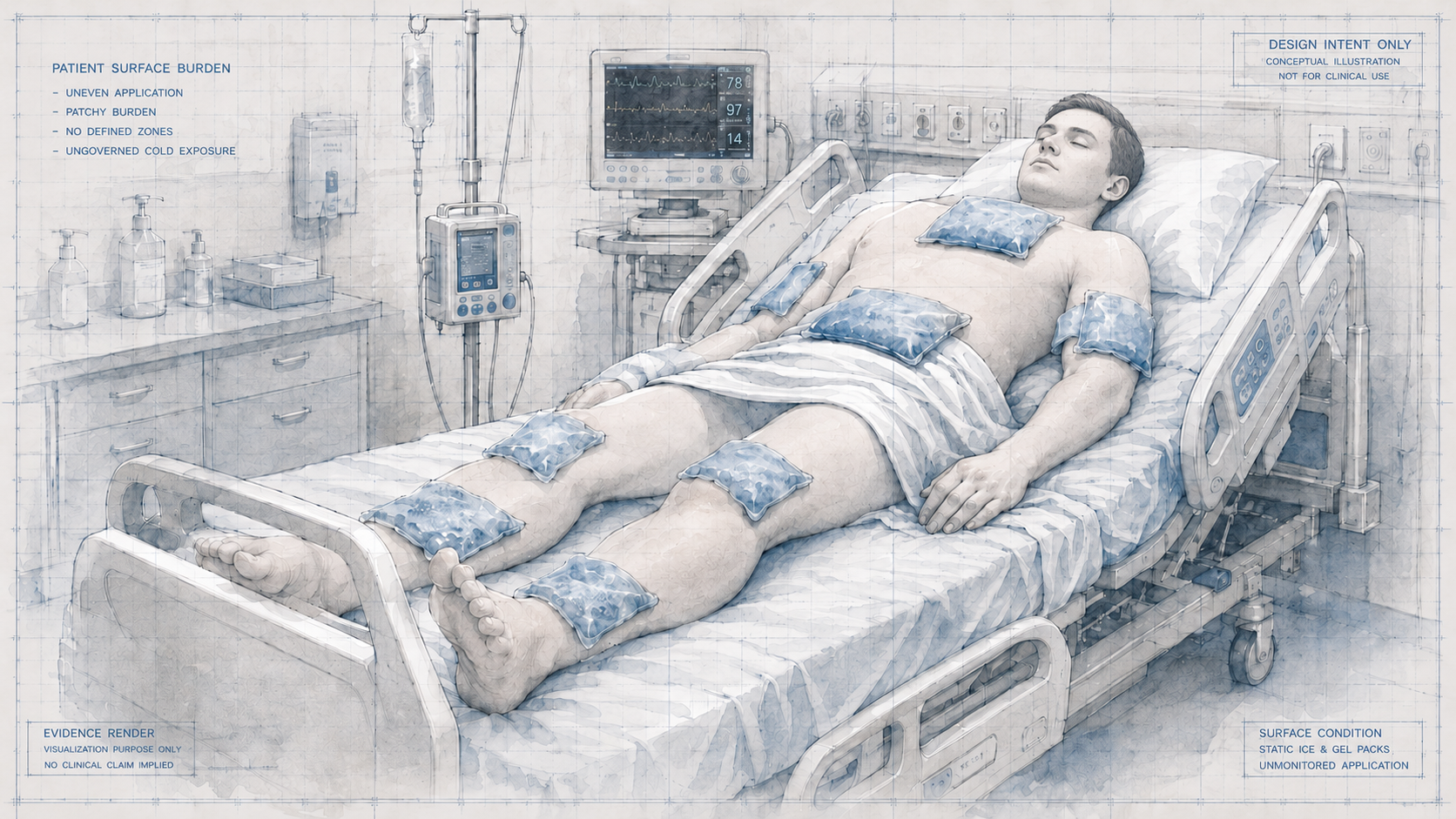
The patient surface is a clinically significant domain. Hospital-acquired pressure injuries affect over 2.5 million individuals annually in the United States and represent one of the most costly and preventable adverse events in hospital settings. The thermal state of the patient surface is a factor in tissue perfusion, pressure zone vulnerability, and clinical recovery environment.
| Patient Surface Burden -- Published Data | Representative Anchor |
|---|---|
| Annual hospital-acquired pressure injuries (U.S.) | Over 2.5 million individuals |
| Annual deaths attributed to pressure injuries (U.S.) | Approximately 60,000 per year |
| Annual cost to U.S. health system | Approximately $25 billion (2023-2024) |
| Individual HAPI care cost per patient | $20,900 to $151,700 per patient (AHRQ estimate) |
| Medicare cost per pressure injury per hospital stay | Approximately $43,180 added per stay |
Sources: NIH, 2024; American Nurse Journal / AHRQ, 2024; Wound Repair and Regeneration, 2024.
CryoFlux makes no claim that CryoBed prevents pressure injuries or reduces HAPI rates. These statistics are cited to establish the clinical significance of the patient surface domain. Any clinical application of CryoBed architecture is subject to clinical team judgment and applicable regulatory requirements.
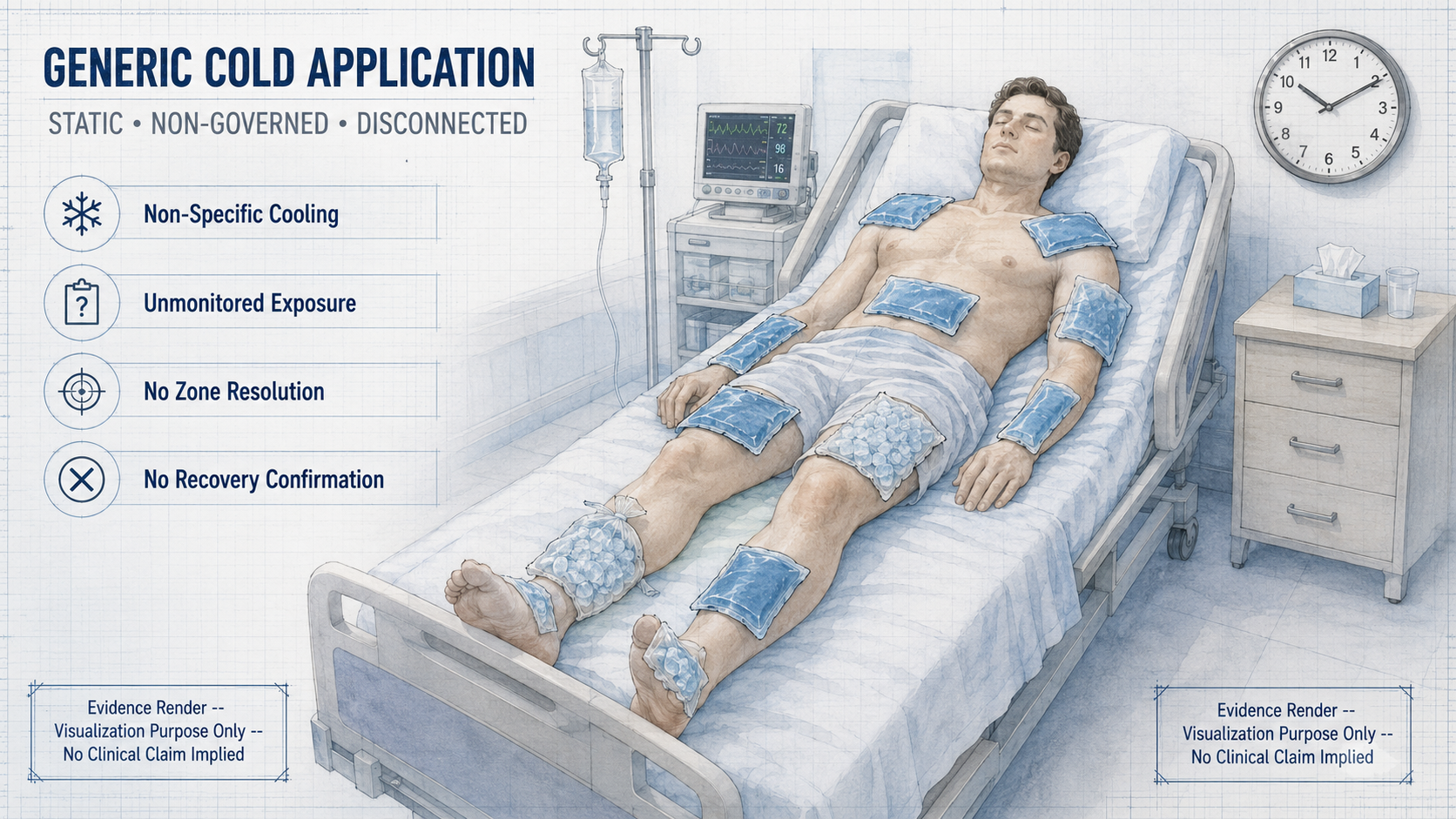
Conventional therapeutic cold application is static, non-governed, and disconnected from the clinical picture. It delivers undifferentiated cold to an undifferentiated surface with no zone resolution, no position awareness, no exposure-window governance, no recovery confirmation, and no cumulative tracking.
| Generic Cold Application Limitation | Nature of Gap |
|---|---|
| Non-specific cooling | Cold applied to surface area regardless of zone-specific burden distribution or patient position |
| Unmonitored exposure | No continuous monitoring of exposure duration, surface temperature, or patient condition response |
| No position awareness | Cold application does not adapt to patient position changes -- HOB angle, lateral tilt, or pressure zone redistribution |
| No recovery confirmation | No documentation of zone recovery state between exposure cycles |
| No cumulative tracking | No record of cumulative cold exposure per zone across the care session or shift |
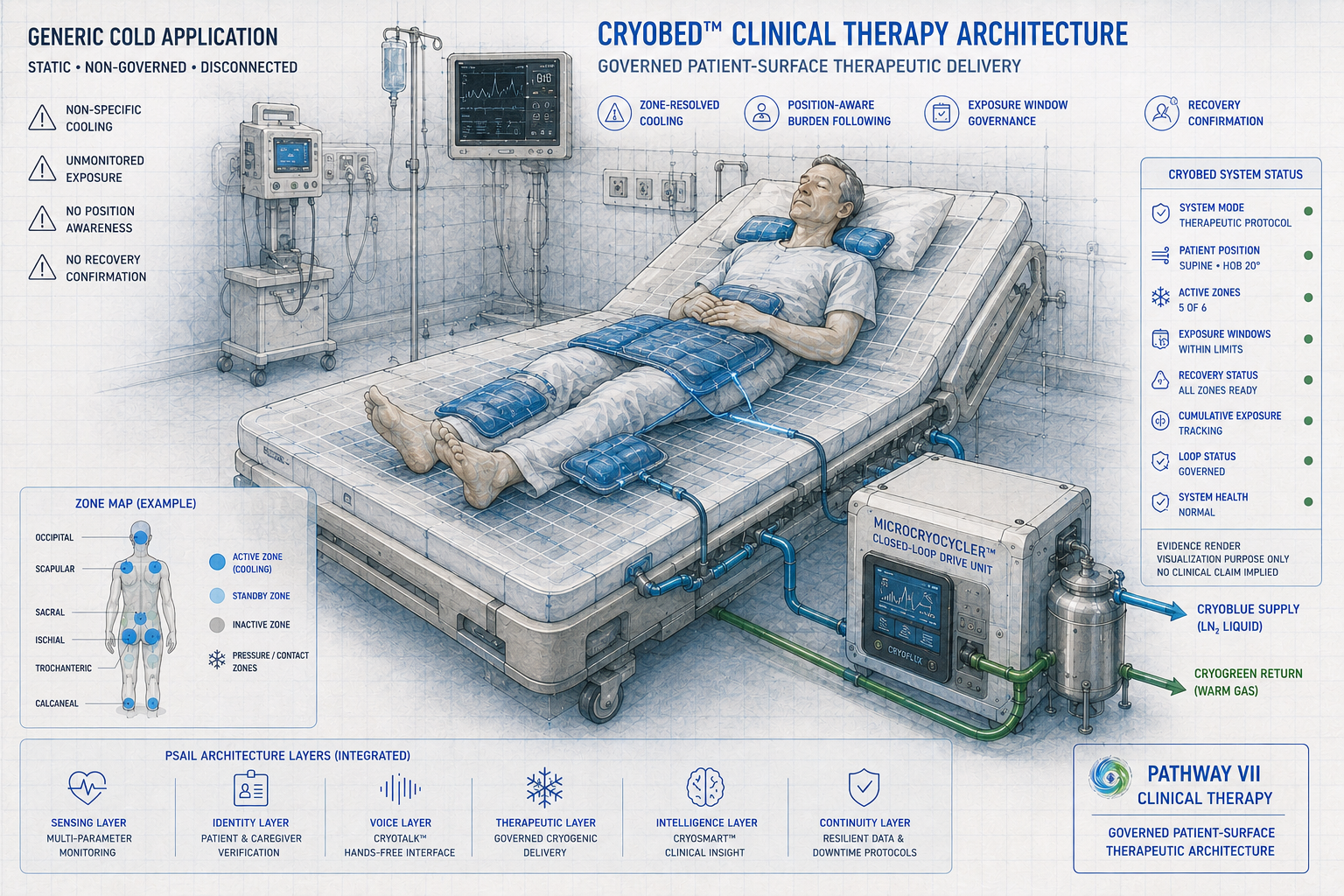
CryoBed governed patient-surface architecture targets each of these gaps as architecture-level design objectives -- zone resolution, position awareness, exposure-window governance, recovery confirmation, and cumulative tracking. Clinical outcomes are the domain of the clinical team. CryoFlux governs the surface thermal architecture.
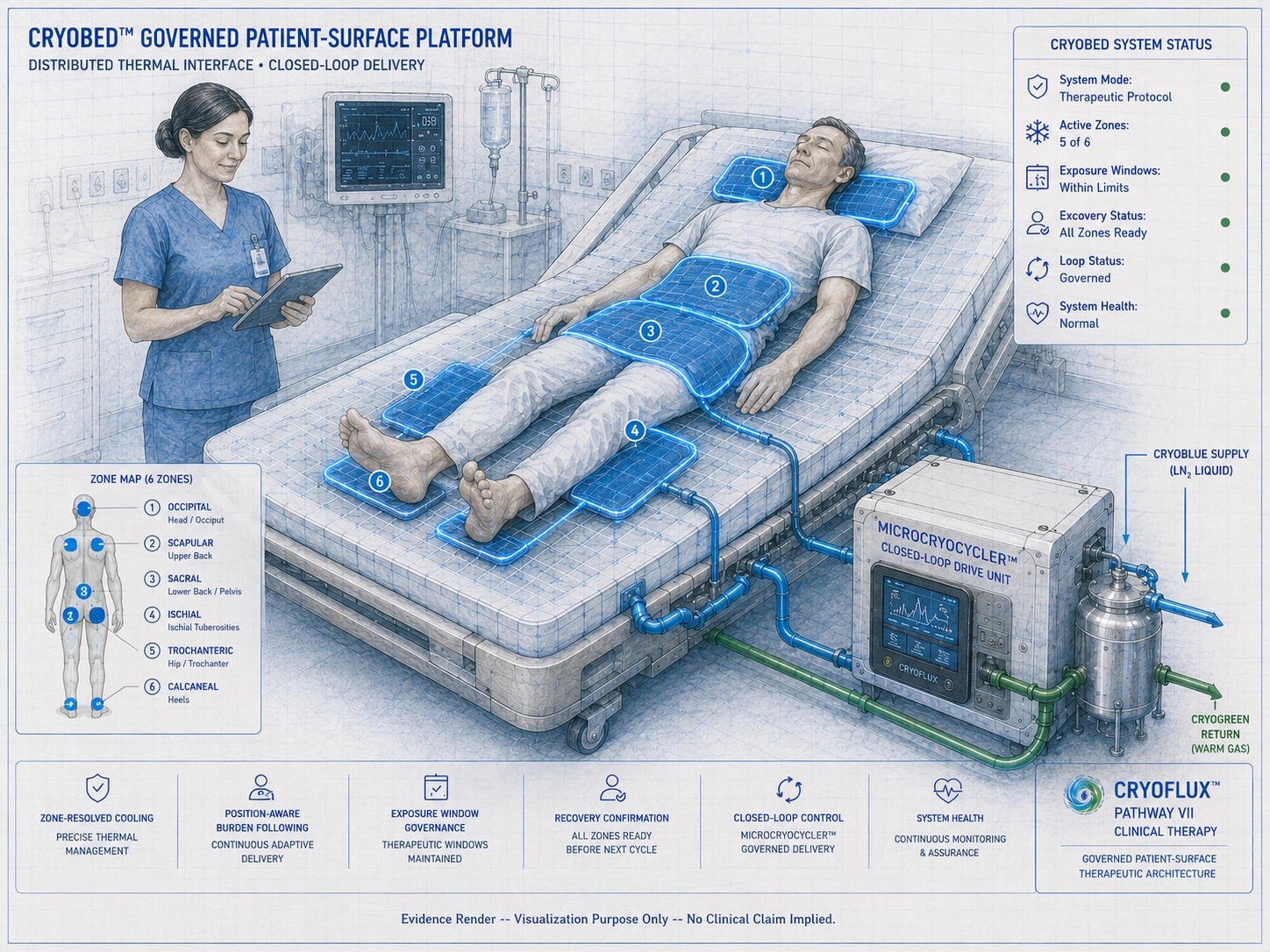
CryoBed is CryoFlux's governed patient-surface therapeutic delivery platform. It delivers zone-resolved, position-aware, exposure-windowed cryogenic cold to the patient surface through the CryoMattress distributed thermal interface, governed and monitored by the MicroCryoCycler closed-loop drive unit.
| CryoBed Architecture -- Design Target | Intended Clinical Infrastructure Meaning |
|---|---|
| Zone-resolved cooling | Independent thermal governance per anatomical zone -- Occipital, Scapular, Sacral, Ischial, Trochanteric, Calcaneal -- matching clinical pressure-zone mapping |
| Position-aware burden following | Surface thermal delivery adapts to patient position changes -- HOB angle, lateral position, pressure redistribution events |
| Exposure window governance | Timed cold exposure windows per zone with programmed limits -- preventing unmonitored over-exposure |
| Recovery confirmation | Zone recovery status confirmed before next exposure cycle -- no zone re-activated before recovery state is documented |
| Cumulative zone tracking | Continuous record of cumulative cold exposure per zone per session -- complete thermal care record available to clinical team |
| Clinical judgment governs all care | CryoBed is a governed surface thermal architecture. All clinical decisions, protocols, and care plans are the exclusive domain of the clinical team. |
Multi-parameter monitoring of the patient surface environment -- temperature, pressure, zone state, and system health continuously reported.
Patient and caregiver verification -- session accountability, care team identification, and protocol association with the governed surface event.
Hands-free clinical interface -- voice-commanded zone activation, status queries, and session control without interrupting patient care workflow.
Governed cryogenic delivery through CryoMattress -- zone-resolved, position-aware, exposure-windowed cold delivery to the patient surface.
Clinical insight architecture -- pattern recognition, zone history, and session analytics available to the clinical team. Not diagnostic. Clinical judgment governs all care.
Resilient data and downtime protocols -- session record preserved through power events, shift changes, and system interruptions.
| Category | Generic Cold Application | CryoBed Governed Patient-Surface Architecture |
|---|---|---|
| Zone resolution | Undifferentiated -- cold applied to surface area without zone mapping or independent zone control | Zone-resolved -- independent thermal governance per anatomical pressure zone |
| Position awareness | Static -- cold application does not adapt to patient position changes | Position-aware -- surface delivery adapts to HOB angle, lateral position, and pressure redistribution |
| Exposure governance | Unmonitored -- no timed exposure limits, no zone-specific windowing | Exposure-windowed -- programmed limits per zone, no zone reactivated before recovery confirmed |
| Recovery confirmation | None -- no documentation of zone recovery state between cycles | Recovery-confirmed -- zone recovery status documented before next cycle initiated |
| Cumulative tracking | None -- no record of cumulative cold exposure across session or shift | Cumulative tracking -- continuous record of exposure per zone per session available to clinical team |
| Claim posture | Generic cold: static, non-governed, disconnected | CryoBed design intent: governed surface thermal architecture. Informational only. Not diagnostic. No clinical outcome claim. Clinical judgment governs all care. |
Zone-resolved. Position-aware. Exposure-windowed. Documented. Governed. Informational only. Clinical judgment governs all care.