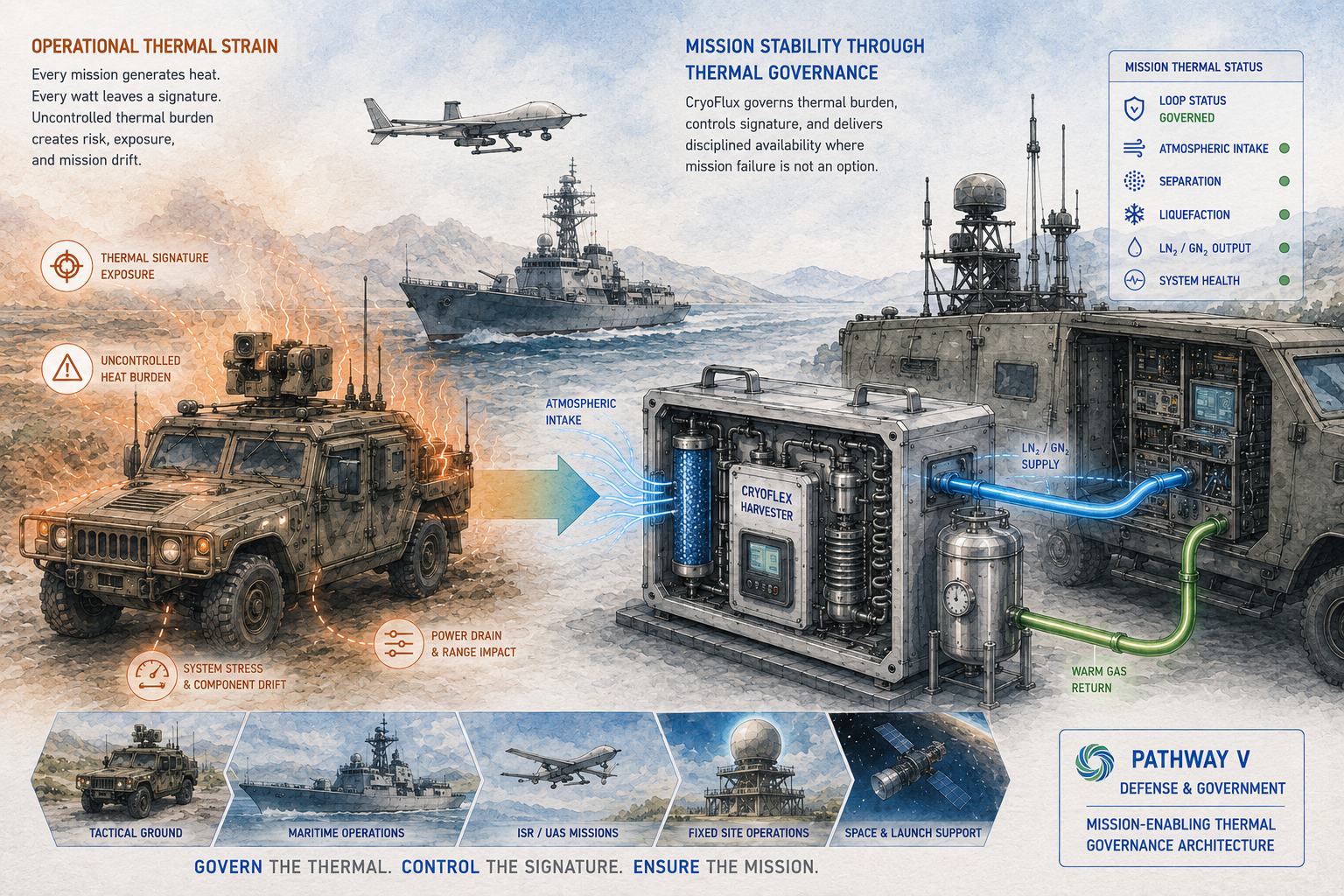
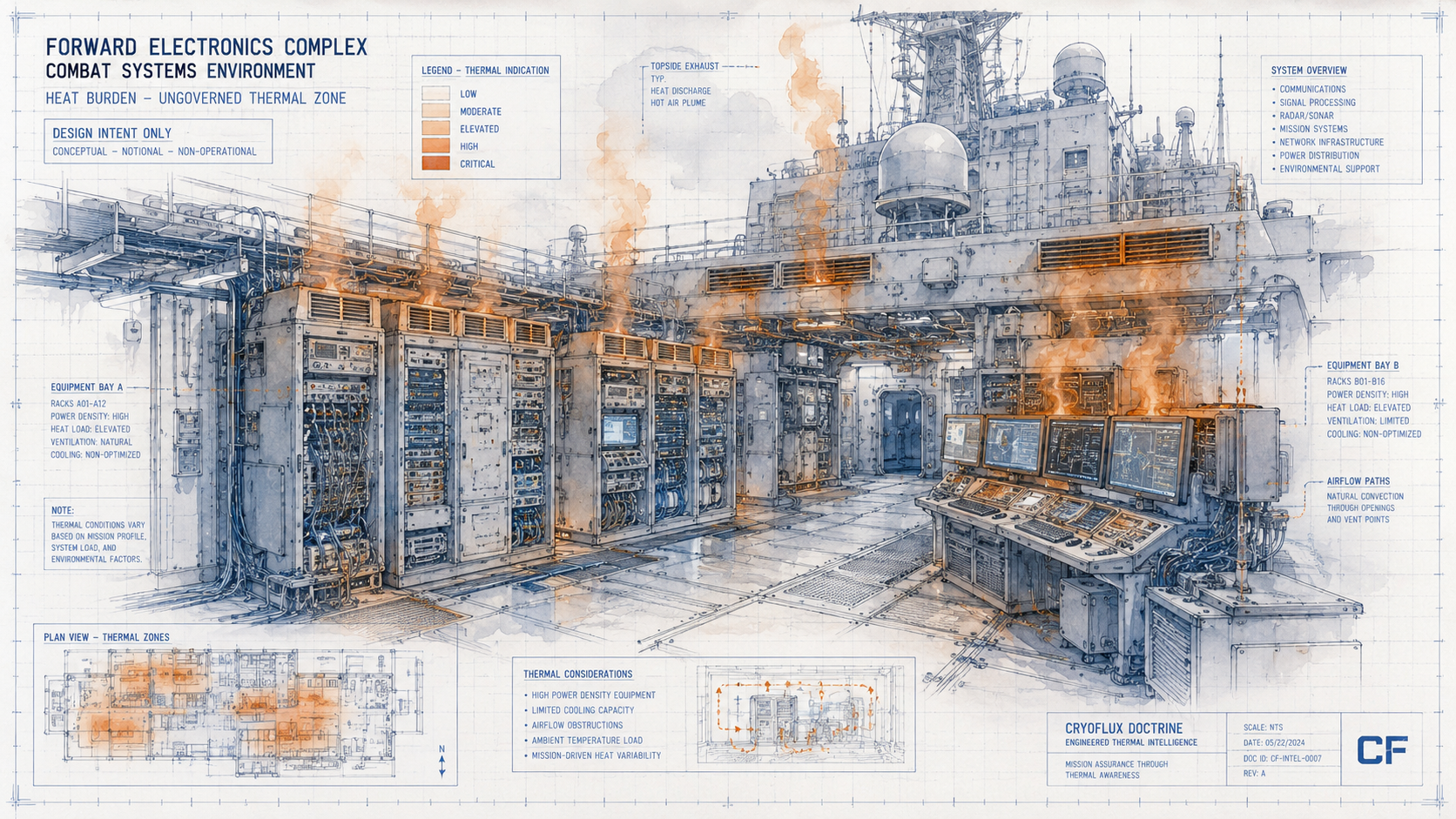
Modern defense electronics are growing more capable and more thermally demanding simultaneously. AI and machine learning processing, electronic warfare systems, and C5ISR computing generate unprecedented heat loads in increasingly compact, ruggedized form factors where traditional air cooling is no longer sufficient.
| Defense Electronics Thermal Burden | Representative Anchor |
|---|---|
| Microelectronic power increase over 20 years | Factor of 100 increase in component power, with accompanying heat flux increase (U.S. Army / University of Maryland) |
| Advanced radar system heat loads | Exceeding 150 kW in advanced systems -- requiring sophisticated cooling solutions |
| Military electronics operating temperature range | -65°C arctic conditions to propulsion environments exceeding 1,100°C |
| SWaP constraint | Size, Weight, and Power requirements mean cooling systems cannot simply be scaled up -- innovation required |
| Environmental vulnerability | Fans and vents highly vulnerable to dust, sand, and vibration in battlefield environments |
Sources: U.S. Army / University of Maryland, 2020; Modus Advanced Defense Thermal Management; Military Embedded Systems.
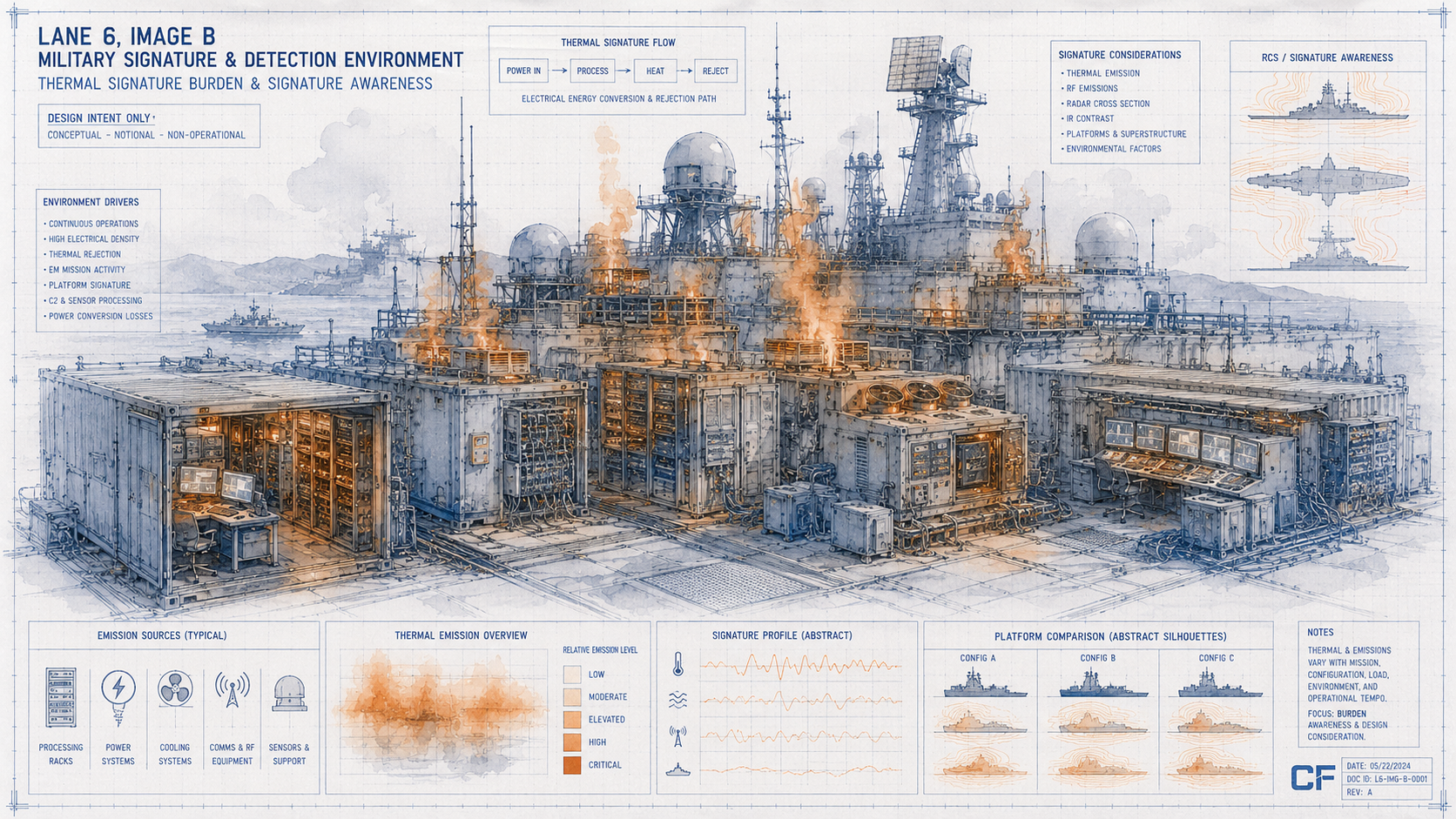
Uncontrolled thermal burden in mission environments is not merely an engineering problem. It is an operational consequence. Thermal signature exposure, system stress and component drift, and power drain and range impact are direct operational outcomes of ungoverned heat in mission hardware.
| Operational Thermal Consequence | Nature of Burden |
|---|---|
| Thermal signature exposure | Uncontrolled heat emission creates detectable signature -- operational risk in contested environments |
| System stress and component drift | Thermal cycling causes material fatigue, calibration drift, and component degradation under sustained operational load |
| Power drain and range impact | Cooling systems consume power from the same source as mission systems -- reducing operational range and endurance |
| Mission system availability | Thermal management failure is a leading cause of mission-critical electronics downtime in deployed environments |
Source: Army Technology, 2025; Military Embedded Systems.
CryoFlux makes no combat-performance claim, no survivability guarantee, no signature-elimination claim, and no quantified range or readiness improvement claim. CryoFlux targets mission-enabling thermal governance architecture -- governing the thermal burden so mission systems can operate at the performance level they were designed for. Specific performance data will be reported from program and pilot results.
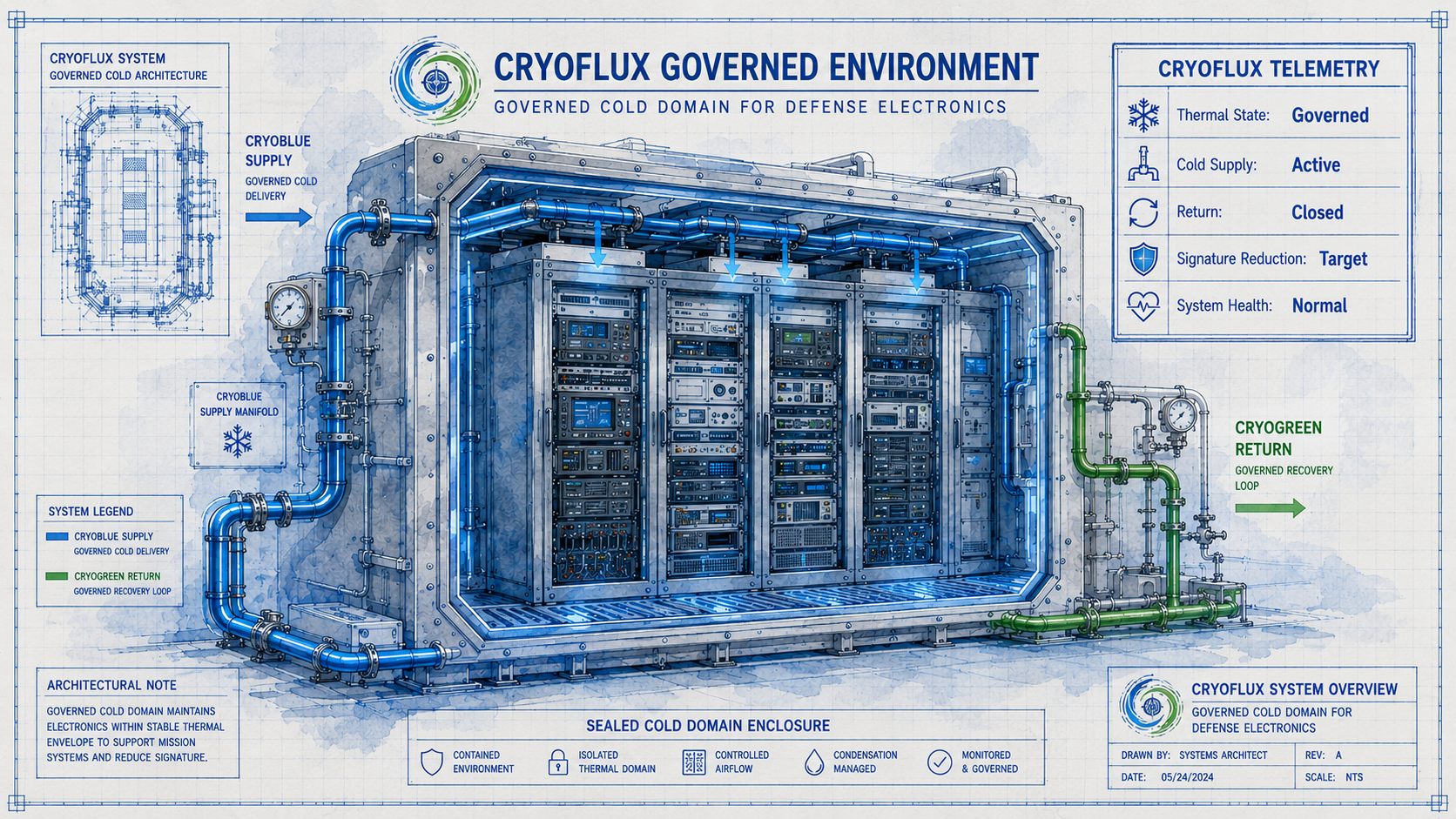
CryoFlux governs the thermal burden of mission systems across five operational domains -- delivering governed cold where thermal exposure, component stress, and power drain are operational consequences, not engineering abstractions.
| CryoFlux Mission Architecture -- Design Target | Intended Operational Meaning |
|---|---|
| Point-of-consumption LN2/GN2 production | Governed cryogenic supply produced at or near the mission platform -- reducing logistics tail and supply dependency |
| Governed thermal delivery to mission hardware | Cold delivered to the thermal burden source -- not ambient air management after heat escapes the system |
| Continuous telemetry | Atmospheric intake, separation, liquefaction, supply, and system health monitored throughout mission -- anomalies reportable in real time |
| Multi-domain applicability | Same governed architecture deployable across tactical ground, maritime, ISR/UAS, fixed site, and space/launch domains |
| No combat-performance claims | CryoFlux governs the thermal architecture. Mission performance, survivability, and signature management are the domain of the platform and mission system. |
The CryoFlex Harvester governs the energy state of the mission thermal loop -- producing governed LN2/GN2 from atmospheric intake at or near the platform, delivering cold to the thermal burden source, and capturing the warm gas return.
CryoVacuLock / CryoVestibule architecture governs the atmospheric boundary of sensitive mission electronics environments -- controlling moisture, contamination, and pressure conditions that protect high-value mission hardware.
CTD geometry at the thermal interface governs the cold delivery contact architecture at the point of thermal burden -- ensuring governed cold reaches the mission hardware thermal source, not only the ambient environment around it.
| Category | Conventional Defense Thermal Management | CryoFlux Mission Thermal Governance |
|---|---|---|
| Thermal control point | Ambient air or liquid cooling after heat escapes the component -- reactive management | Governed cold delivery to the thermal burden source -- before propagation to the platform environment |
| Working medium | Air, water/glycol, or conventional refrigerants -- all with SWaP, environmental, and logistics constraints | LN2/GN2 from atmospheric harvesting -- produced at the point of need, inert, no high-GWP regulatory exposure |
| Supply dependency | Refrigerant and coolant supply chain dependencies in deployed environments | Atmospheric intake harvesting -- nitrogen produced from ambient air; logistics tail targeted for reduction |
| Monitoring | Periodic maintenance; component monitoring after failure events rather than continuous thermal state governance | Continuous telemetry: intake, separation, liquefaction, supply, system health -- anomaly detection during operation |
| Multi-domain applicability | Platform-specific cooling solutions not architecturally transferable across domains | Same CryoFlux governed architecture deployable across tactical ground, maritime, ISR, fixed site, and space domains |
| Claim posture | Conventional: component-level thermal management, platform-specific engineering | CryoFlux design intent: mission-enabling thermal governance. No combat claim. No survivability guarantee. No signature-elimination claim. |
Point-of-consumption atmospheric harvesting targets significant reduction in the logistics tail required to maintain mission system thermal architecture in deployed environments. LN2/GN2 produced from ambient air eliminates the specialized coolant supply chain that conventional thermal management requires.
CryoFlex Harvester is designed as a deployable governed unit -- compact, self-contained, and architecturally transferable across mission domains. The same governed thermal architecture applicable to tactical ground, maritime, ISR, fixed site, and space/launch environments without platform-specific redesign.
Conventional defense cooling systems carry HFC/HFO refrigerant dependencies subject to EPA phase-down regulations and supply chain constraints. CryoFlux targets zero high-GWP refrigerant dependency in the governed thermal architecture -- LN2 from atmospheric nitrogen carries no regulatory phase-down exposure.
Mission-enabling thermal governance architecture across five operational domains.