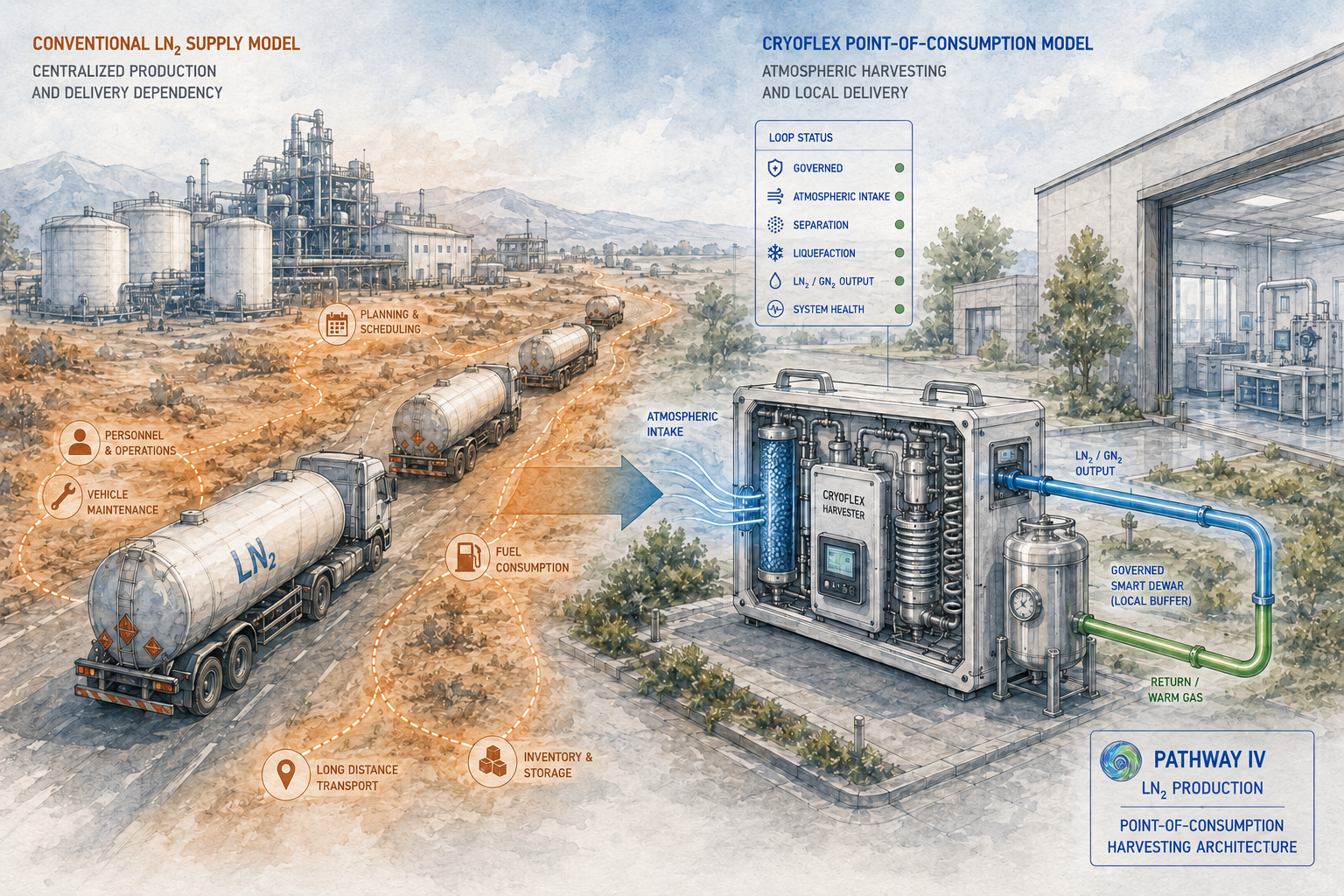
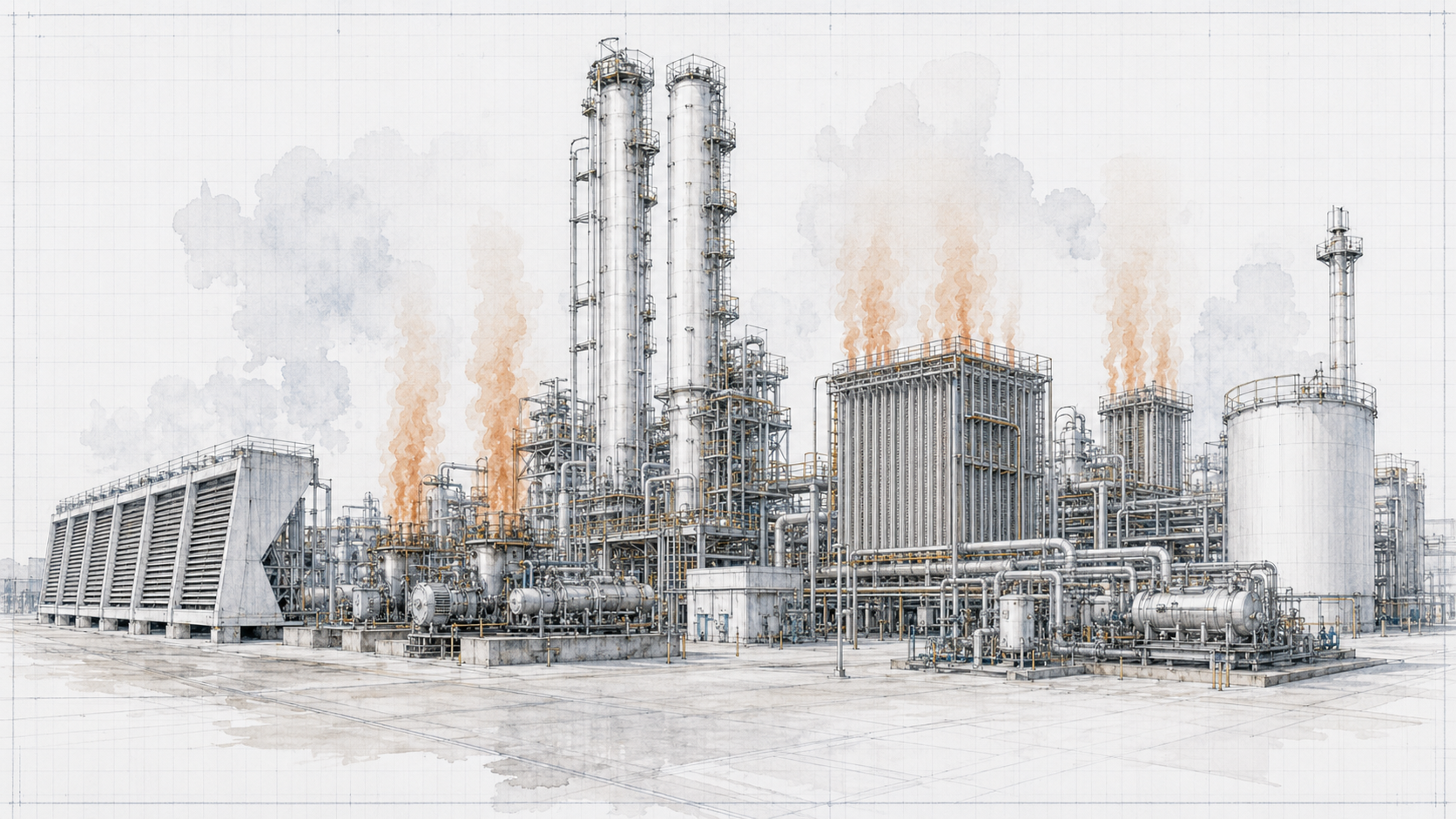
Nitrogen makes up 78% of the atmosphere. It is effectively unlimited as a raw resource. Yet the conventional LN2 supply model converts this abundant atmospheric resource into a delivered commodity carrying a markup of approximately 40 times production cost.
| Conventional LN2 Supply Burden | Representative Anchor |
|---|---|
| Supplier production cost per liter | Less than $0.0016 per liter |
| Bulk delivery price per liter -- U.S. market | $0.70 to $1.33 per liter |
| Effective markup over production cost | Approximately 40 times |
| Price increase frequency | Consistently twice per year over last five years |
| Off-gassing loss rate | Up to 5% of supply per day in storage |
| U.S. companies estimated to overpay | Approximately 80% |
Sources: Liquid Nitrogen Generators LLC; Rutherford & Titan.
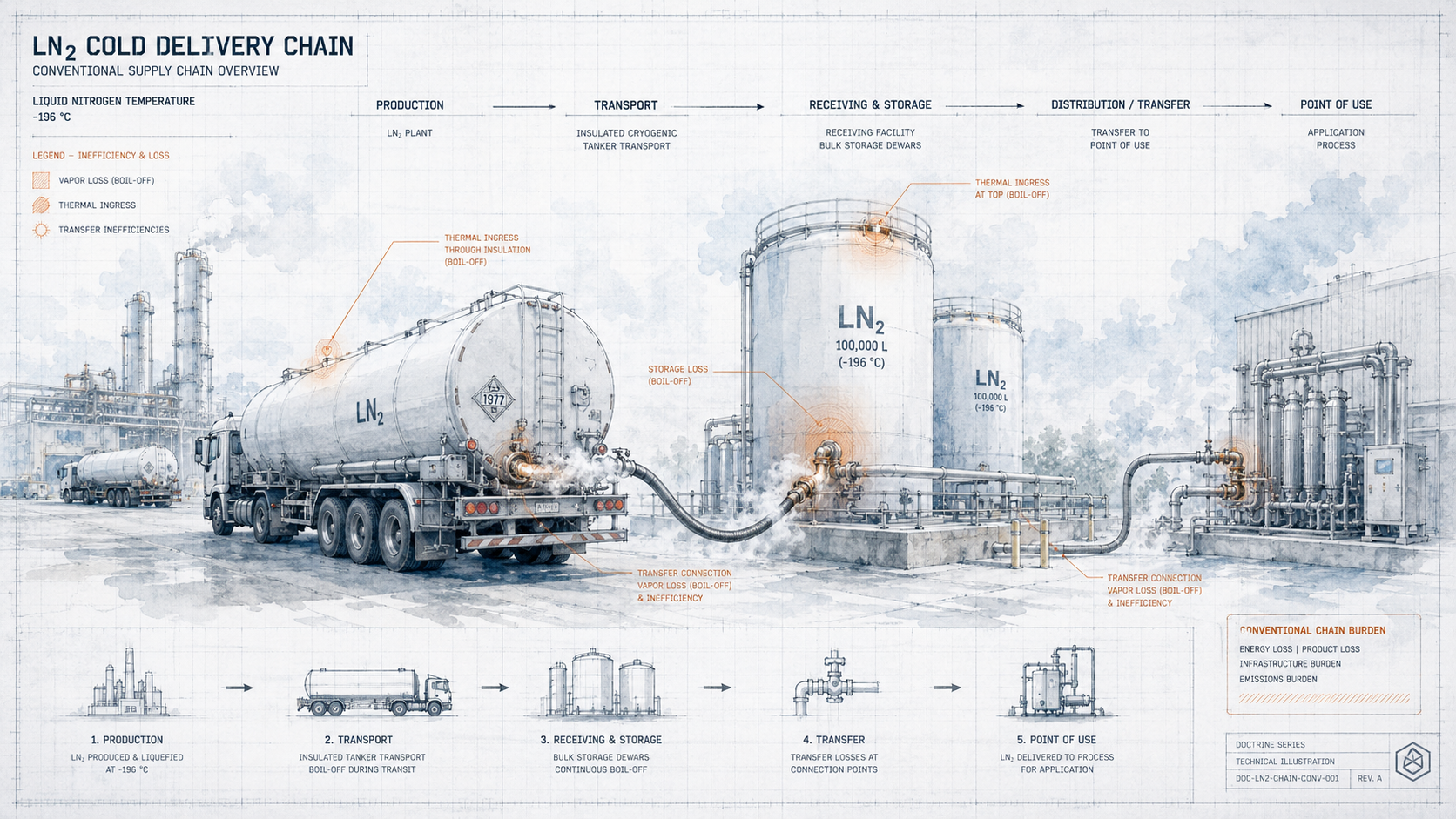
The conventional LN2 supply model requires the buyer to absorb an entire logistics infrastructure: planning and scheduling, personnel and operations, vehicle maintenance, fuel consumption, long-distance transport, inventory management, and storage. None of these costs appear in the per-liter price quote.
| Hidden Cost Category | Nature of Burden |
|---|---|
| Storage infrastructure | New 230L dewar approximately $4,500; monthly rental $10 to $30 per cylinder; installation permits and concrete plinth required |
| Delivery scheduling dependency | Delays and supply shortages can cause operational blockage and missed business opportunities |
| Off-gassing loss | Up to 5% of paid supply evaporates daily in storage -- a paid-for resource never consumed |
| Market range -- small volume users | $2.00 to $5.00 per liter for laboratory and clinical quantities |
| Global nitrogen market size (2023) | Approximately USD 44.2 billion; projected 9.9% CAGR through 2030 |
Sources: Rutherford & Titan; Grand View Research Nitrogen Procurement Report.
CryoFlux does not claim a specific cost-per-liter reduction or production volume guarantee. CryoFlex Harvester targets the architectural shift from centralized supply-chain dependency to governed point-of-consumption production -- harvesting nitrogen from the atmosphere at or near the point of need. Performance specifications will be reported from pilot program data.
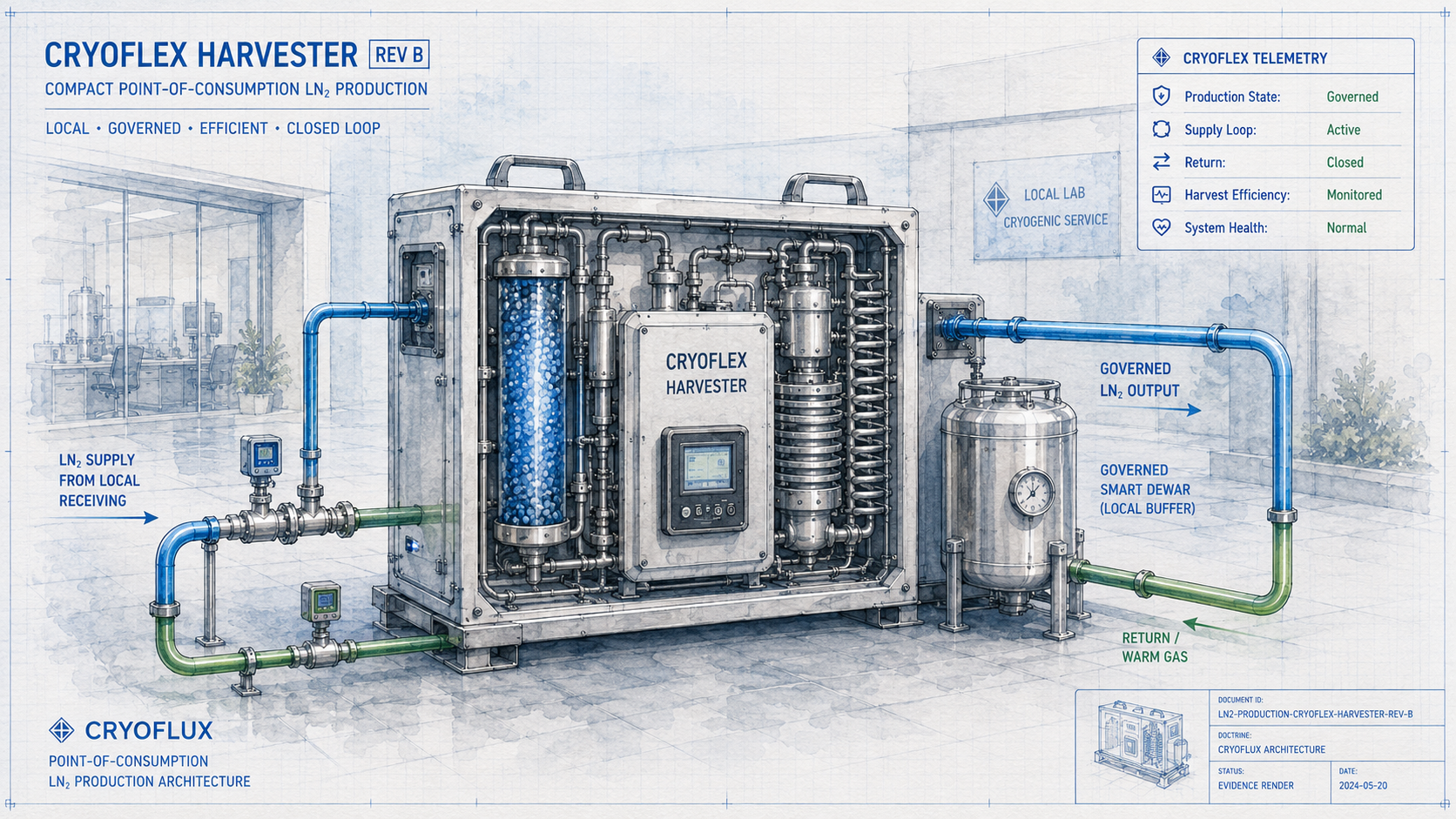
CryoFlex Harvester targets the conversion of LN2 from a delivered commodity into a locally governed, atmospherically harvested resource -- produced at or near the point of consumption, reducing dependency on the centralized production and delivery supply chain.
| CryoFlex Harvester Design Target | Intended Commercial Meaning |
|---|---|
| Atmospheric intake harvesting | Nitrogen sourced directly from the atmosphere at or near the point of consumption -- 78% of air is nitrogen |
| Point-of-consumption production | LN2 produced where it is needed, reducing or eliminating long-distance transport dependency |
| Governed Smart Dewar local buffer | On-site governed storage with monitored fill level, temperature, and system health -- no off-gassing loss to unmonitored passive storage |
| LN2 and GN2 dual output | Both liquid and gaseous nitrogen output available from the same governed harvesting unit |
| Return warm gas capture | Warm gas return pathway governed and recaptured -- reducing atmospheric venting from the production loop |
| No production volume or cost claim | Specific output volumes and cost-per-liter figures will be reported from pilot program data. No guarantee implied. |
The CryoFlex Harvester governs the energy state of the liquefaction process -- atmospheric intake, separation, and liquefaction managed as a governed loop rather than a centralized industrial batch process.
The CryoVacuLock / CryoVestibule architecture governs the atmospheric boundary of the harvesting and storage environment -- preventing contamination of the separation and liquefaction process and maintaining purity of the governed output.
The Governed Smart Dewar local buffer monitors fill level, temperature, and system health in real time -- replacing the passive, unmonitored storage of conventional bulk delivery with an instrumented local supply architecture.
| Category | Conventional LN2 Supply Model | CryoFlex Point-of-Consumption Architecture |
|---|---|---|
| Production location | Centralized industrial facility -- remote from point of consumption | At or near point of consumption -- atmospheric harvesting where needed |
| Supply-chain dependency | Full dependency on planning, scheduling, transport, storage, and delivery logistics | Atmospheric intake -- nitrogen sourced from ambient air; delivery dependency targeted for reduction |
| Price markup | Approximately 40 times production cost charged to end user; prices rising twice per year | Point-of-consumption production targets reduced effective cost -- specific figures pending pilot data |
| Off-gassing loss | Up to 5% of paid supply lost daily to passive storage off-gassing | Governed Smart Dewar with monitored fill and temperature -- passive loss architecture replaced by active governance |
| Monitoring | Periodic delivery and manual inventory checks; no continuous supply health telemetry | Continuous telemetry: atmospheric intake, separation, liquefaction, output, buffer level, system health |
| Claim posture | Conventional model: delivered commodity, variable pricing, logistics dependency | CryoFlex design intent: governed point-of-consumption production. No output volume guarantee. No cost claim until pilot data. |
Conventional LN2 delivery requires specialized tanker trucks, fuel consumption, vehicle maintenance, and road infrastructure for every delivery cycle. Point-of-consumption production targets significant reduction in delivery miles and associated emissions by producing supply where it is consumed.
Passive bulk storage loses up to 5% of supply daily to off-gassing -- nitrogen produced, transported, stored, and vented without ever being used. Governed Smart Dewar architecture targets active monitoring and loss reduction by replacing passive storage with instrumented supply governance.
Unlike helium, which is finite and non-renewable, nitrogen constitutes 78% of the atmosphere -- it is effectively unlimited as a raw resource. Point-of-consumption harvesting uses the most abundant available input and eliminates the supply-chain infrastructure built around artificially scarce delivery logistics.
CryoFlex Harvester is the governed architecture that puts it to work at the point of consumption.